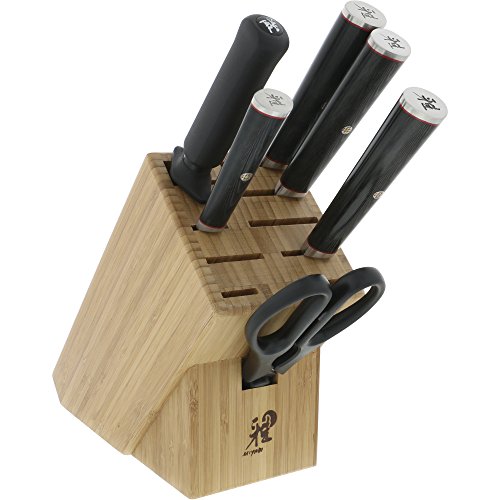
If the Wüsthof Classic 7-Piece is the traditional German answer, the Miyabi Kaizen 7-Piece is its opposite: a thin, hand-honed, Damascus-clad Japanese set from a brand owned by Zwilling. It ranks fourth in our best knife sets of 2026. This profile covers what the set contains, what Zwilling says about the steel and the edge, how to look after a blade like this and which cook should consider it.
We do not run our own kitchen trials, and Bon Appétit’s testing of this exact set is not among the sources we opened, so this profile relies on Zwilling’s own product page for Miyabi Kaizen. Where we offer general knife-care advice that does not come from Zwilling, we say so.
The Short Version
Zwilling describes Kaizen, a Japanese word for “improvement” or “change for the better,” as a line that combines hardening technology with traditional Japanese craftsmanship. The resilient core is VG10 super steel, protected by a 64-layer flower Damascus pattern. The blades are CRYODUR ice-hardened, and artisans hand-hone them using the historic Honbazuke method. Zwilling lists the finished edge at 9.5 to 12 degrees and the hardness at Rockwell 60.
The result is a set that is more about sharpness and presentation than about brute strength. The handle is a D-shaped black linen Micarta, and the whole thing is handcrafted in Seki, Japan, with a lifetime warranty according to Zwilling.
What Is in the Box
Zwilling lists these pieces:
- 3.5-inch vegetable knife, a small knife for trimming and peeling
- 6-inch utility knife
- 8-inch chef’s knife
- 9.5-inch bread knife
- 9-inch sharpening steel
- Kitchen shears
- Bamboo block, listed with a slot count of 10
Ten slots and seven pieces mean a few slots stay open. The set is a good base for adding a santoku or a slicing knife from the same line later, though you should check the slot sizes first, since the page does not give them.
The bread knife is unusually long. At 9.5 inches it is longer than the 9-inch bread knives in the Shun set and the 8-inch bread knives in the Wüsthof and Zwilling Pro sets. A longer serrated blade helps with wide loaves.
Steel, Layers and Edge
The technical terms on a Japanese knife can blur together, so here is what Zwilling says.
VG10 core. Zwilling calls VG10 a premium Japanese super steel intended for long-lasting, razor-sharp edges. It forms the resilient core of the blade.
Flower Damascus cladding. Zwilling says a 64-layer flower Damascus pattern protects the core and adds durability, producing a 65-layer blade. The pattern is also a visual feature, and Zwilling calls the design beautifully modern with stunning Damascus steel.
CRYODUR ice-hardening. The ice-hardening treatment is credited with exceptional hardness and corrosion resistance, and the blade is ice-hardened to Rockwell 60. For comparison, the Wüsthof Classic is listed at 58 HRC and the Zwilling Four Star at 57 Rockwell by their respective makers. These numbers come from different companies, so treat the comparison as a rough guide, not a lab result.
Honbazuke hand-honing. Artisans hand-hone the blades with the three-step Honbazuke process, which Zwilling says gives a scalpel-like edge at 9.5 to 12 degrees. A lower angle means a thinner edge. For context, the makers of two other sets in our lineup quote 14 degrees per side (Wüsthof) and 16 degrees per side (Shun). The three numbers are not directly comparable because of how each company measures and describes its edge, but they point the same way: the Miyabi edge is the thinnest of the three.
Authentic Japanese profile. Zwilling describes a thin Japanese blade profile with a full tang for balance and cutting performance. It describes the handle as a traditional D-shaped black linen Micarta handle with a wood-like texture that will not slip and repels moisture.
Care and Handling
Zwilling’s page has no care section for this set, so what follows is general knife-care advice, not a Miyabi instruction. Check the care leaflet that ships with the knives for the maker’s own directions.
- Wash by hand with warm water and mild soap, then dry right away. Dishwashers are rough on thin edges and handles.
- Use a wood or plastic board. Glass, stone and ceramic dull any knife quickly.
- Keep thin, hard blades away from bones, frozen food and hard squash. Those are the jobs where an acute edge is most likely to chip or roll.
- Hone lightly and often rather than pressing hard. For sharpening, use a whetstone or a service that works with Japanese knives, at a shallow angle.
- Store knives in the block or on a protected rack, never loose in a drawer. This is common sense, not a safety guarantee. No block set prevents accidents, and careless handling of a very sharp knife can cause serious cuts.
How It Compares
The Shun Classic 7-Piece Essential is the obvious rival. Both are Japanese-made Damascus-clad sets in bamboo blocks. The Shun uses a VG-MAX core and a 16-degree edge, with Pakkawood handles and a more Western-leaning shape, and Bon Appétit has published praise for it. The Miyabi uses VG10, a thinner edge, Micarta handles and a more traditionally Japanese profile, but none of the sources we opened evaluates this exact set independently. If you want outside confirmation of performance, the Shun is better documented. If you want the thinnest edge and the more distinctive look, the Miyabi is the one to consider.
Against the Zwilling Pro 7-Piece In-Drawer, the difference is philosophy. The Zwilling Pro is forged German steel built for sturdiness, with a tray to save counter space. The Miyabi is thin and refined and wants a bit more care.
Pros and Cons in Detail
What stands out
- A VG10 core, Damascus cladding and CRYODUR ice-hardening to Rockwell 60, per Zwilling.
- A hand-honed 9.5 to 12 degree edge, thinner than the edge angles quoted for Shun or Wüsthof.
- Black linen Micarta handles that Zwilling says resist slipping and repel moisture.
- Handcrafted in Seki, Japan, with a lifetime warranty.
- A 9.5-inch bread knife and a bamboo block with spare slots.
What to weigh
- A fine, hard edge asks for careful use and gentle surfaces.
- Only four knives. No steak knives, no boning knife.
- None of the sources we opened offers an independent evaluation of this exact set.
- The set’s finish and hand work place it among the premium options.
Who It Is For
The Miyabi Kaizen 7-Piece suits a cook who values precision cuts and the look of Damascus steel, and who is ready to hand-wash, hone and handle knives with care. It is a good pick for vegetable-heavy cooking, slicing fish and fine knife work. It also makes a striking gift for someone who enjoys cooking.
It is not the right set for a busy household that wants to toss knives in the dishwasher, for a cook who regularly cuts through bones or frozen food, or for a beginner who wants the most forgiving knife. Those readers should start with the Wüsthof or a sturdier German set.
Bottom Line
The Miyabi Kaizen 7-Piece is the most acute-edged and most decorative set in this group, backed by a detailed spec sheet from Zwilling. The trade-off is that it needs careful handling. For the full ranking and how it fits among all eight sets, go back to our best knife sets of 2026.
Sources