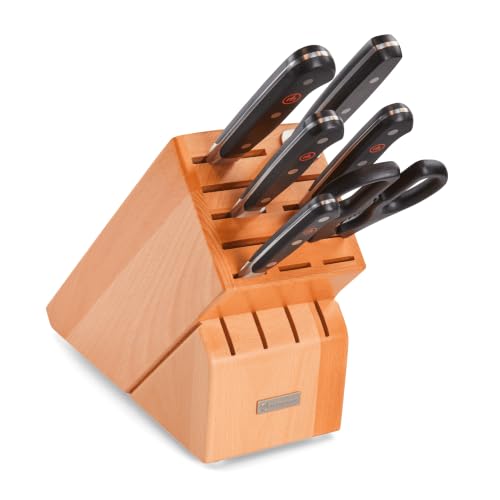
The Wüsthof Classic 7-Piece is the set many people picture when they think of a “proper” kitchen knife block: black triple-riveted handles, a visible bolster, a German-profile chef’s knife and a tall wooden block on the counter. It is also the top pick in our best knife sets of 2026 ranking. This profile goes through what Wüsthof says is in the box, how the knives are made, where the set falls short and which kind of cook it fits. If you are weighing it against a Japanese-style alternative, the Shun Classic 7-Piece Essential profile is the closest comparison.
We do not run kitchen trials of our own. Everything below comes from Wüsthof’s product page and care notes, plus what Bon Appétit reported from its own testing of the Wüsthof Classic line. We keep those two sources separate so you can tell which claims come from the maker and which come from an outside publication.
The Short Version
Wüsthof lists the set as a fully forged block set. The blades are forged from a single block of high-carbon stainless steel and tempered to 58 HRC on the Rockwell scale, according to Wüsthof. The company also says its PEtec precision edge technology yields a blade that is 20 percent sharper with twice the edge retention of previous models. Those are manufacturer claims, and we present them as such: they describe Wüsthof’s own comparison with its earlier knives, not an independent measurement.
The set is built around an 8-inch chef’s knife, a 3.5-inch paring knife, a 6-inch utility knife and an 8-inch bread knife. A honing steel and pull-apart shears round out the working pieces, and a 15-slot block stores everything with plenty of empty slots left over. It is a classic “starter for life” configuration: the three knives most home cooks reach for daily, one mid-size utility blade, and the maintenance tools to keep them in shape.
What Is in the Box
According to Wüsthof, the Classic 7-Piece set includes:
- Classic 3.5-inch paring knife for peeling, trimming and small hand-held work.
- Classic 6-inch utility knife for sandwiches, fruit and tasks too big for the paring knife but too fussy for the chef’s knife.
- Classic 8-inch chef’s knife, the main workhorse for chopping, slicing and dicing.
- Classic 8-inch bread knife with a serrated edge for crusty loaves and tomatoes.
- 9-inch triple-rivet honing steel for regular edge maintenance.
- Pull-apart kitchen shears that come apart for cleaning.
- 15-slot natural knife block, listed at 10.5 inches long, 4.5 inches wide and 8.5 inches high.
Because the block has 15 slots and the set fills only a handful, you can add steak knives, a boning knife, a santoku or a carving knife later without buying new storage. Wüsthof also notes that the color and grain of each block will vary because of the nature of the wood.
Construction and Materials
Wüsthof’s product page is specific about how the Classic line is built. Each blade is forged from one piece of high-carbon stainless steel and tempered to 58 HRC. The handles are full tang, triple-riveted and made of synthetic polypropylene, which Wüsthof says resists fading, discoloration, heat and impact. The company calls the triple-riveted design a favorite for generations and describes the line as having perfect balance.
Wüsthof’s FAQ explains the difference between forged and stamped knives in its own words. Forged knives go through more than 40 steps in the factory and include a bolster, which helps balance the knife. Laser-cut stamped blades go through 14 steps, cost less, weigh less and have no bolster. That is the single biggest difference between a set like this and an entry-level block, and it explains both the weight and the premium position of the Classic line.
On origin, Wüsthof lists Germany for the knives and China for the block. The company states that it has made products in Solingen, Germany, since 1814, and that its knives are hand-finished there. If a German-made block matters to you, note the split before you buy.
How It Compares With the Competition
Bon Appétit, which tests knife sets on its own and publishes the results, describes the Wüsthof Classic line as helping to define high-end knives in both home and professional kitchens. In its writeup of the Classic 3-Piece starter set, the publication says Wüsthof’s 8-inch chef’s knife has been a standout for many years in its testing and that the bread and paring knives are also great options. We cite that as a statement about the Classic line’s knives, not as a verdict on this exact seven-piece block.
Bon Appétit also names the catch. Many cooks prefer more nimble Japanese-style and hybrid knives, and Wüsthof’s heritage puts the Classic line in a more expensive bracket. If you like the heft and durability of a Western-style knife, the publication says it is hard to go wrong, and that the knives should last a lifetime with good upkeep.
Within our ranking, that translates into a clear contrast with the next three sets. The Shun set uses thinner, lighter Japanese-influenced blades; the Zwilling Pro 7-Piece In-Drawer is also a forged German set but swaps the countertop block for a drawer tray; and the Miyabi Kaizen set leans fully Japanese. The Wüsthof is the one to pick if you want the classic German chef’s-knife feel in a conventional block.
Care, Sharpening and Storage
Wüsthof’s care instructions are short and worth following:
- Wash by hand and immediately towel-dry.
- Avoid abrasive sponges and do not leave knives soaking in the sink.
- Store knives with a proper storage solution, such as the included block.
- Avoid cutting on hard surfaces such as metal, glass or hardwoods like bamboo.
- Hone regularly. Sharpen as needed with a whetstone, sharpening steel or hand-held sharpener.
The company also gives a sharpening angle of 14 degrees per side for standard blades and 10 degrees per side for Asian-style blades such as santokus and nakiris, and recommends using the same brand of sharpener where possible so the sharpener’s material hardness matches the steel. If you are not comfortable sharpening at home, Wüsthof points to a mail-in professional sharpening service on its site.
Handling tips are common sense rather than guarantees: cut on a wood or plastic board, keep fingers curled away from the blade, and return knives to the block after drying instead of leaving them loose in a drawer or sink. Wüsthof does not claim that any set prevents injuries, and neither do we.
Pros and Cons in Detail
What stands out
- A forged, full-tang build with a bolster, which Wüsthof says helps balance the knife.
- A 58 HRC hardness figure and a stated 14-degree-per-side sharpening angle, so you know what you are maintaining.
- A honing steel and shears in the box, which many cheaper sets leave out.
- A 15-slot block with a lot of expansion room.
- Strong standing: Bon Appétit calls the Classic line’s 8-inch chef’s knife a standout over many years.
What to weigh
- Only four knives. There are no steak knives, no boning knife and no carving knife, so a cook who regularly roasts meat will want add-ons.
- The feel is traditional and weighty. Cooks who prefer a light, thin blade may find a Japanese-style set more comfortable.
- Hand-wash-only care. Wüsthof tells you to wash by hand and dry immediately.
- The block is made in China even though the knives come from Germany.
- Premium positioning: this is one of the more expensive sets we cover, and a badge on the page will show the relative price tier.
Who It Is For
The Classic 7-Piece fits a cook who wants one dependable set and does not intend to swap it out. It suits people who chop a lot of vegetables with a rocking motion, who like a knife with some weight behind it, and who are comfortable with a honing routine. It also makes a sensible wedding or housewarming gift for someone setting up a first real kitchen, because the block leaves room to grow.
It is a weaker match for a very small kitchen where a 10.5 by 4.5 inch block takes up too much counter. In that case the Zwilling Pro In-Drawer set uses a tray instead. It is also not the best choice if you mostly want Japanese-style precision slicing, where the Shun Classic 7-Piece Essential is the natural alternative.
Bottom Line
The Wüsthof Classic 7-Piece is a conservative, well-documented choice. The manufacturer publishes its steel hardness, its manufacturing method, its sharpening angle and its care rules, and an independent publication has praised the line’s chef’s knife. The trade-offs are the weight, the narrow knife selection and the upkeep. If those suit you, this is a set to buy once and add to over time. For the full ranking and side-by-side comparison, return to our best knife sets of 2026.
Sources