We earn a commission if you buy through our links, at no extra cost to you.
Best Knife Set for Beginners: What Matters First
Buying your first real knife set? Learn the three knives that matter, forged vs. stamped, Western vs. Japanese edges, honing and care, then see five starter sets.
At a glance
A beginner needs three good knives: an 8-inch chef's knife, a paring knife and a bread knife, plus a way to hone them. The Wüsthof Classic 7-Piece covers those in forged German steel, the Victorinox Fibrox 8-Piece is the easy-care option, and the Henckels Statement 15-Piece gives a first kitchen the most pieces.
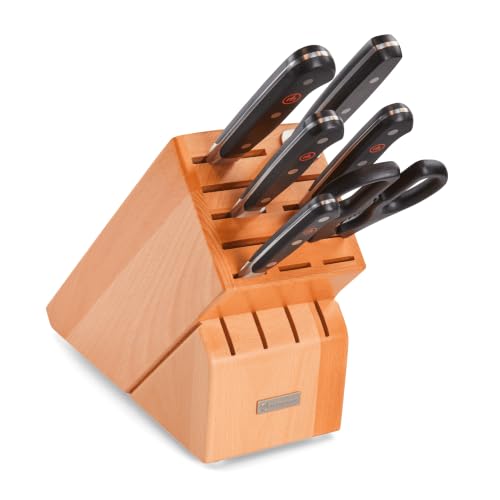
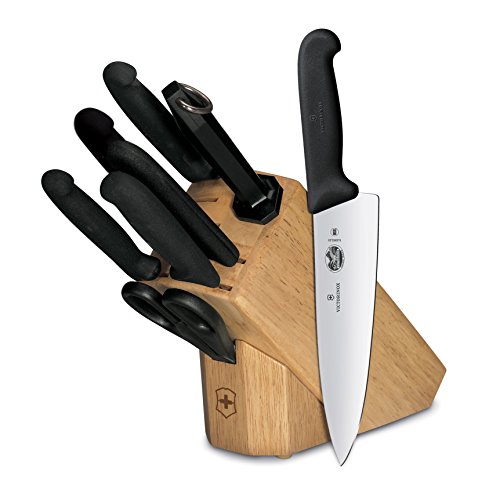
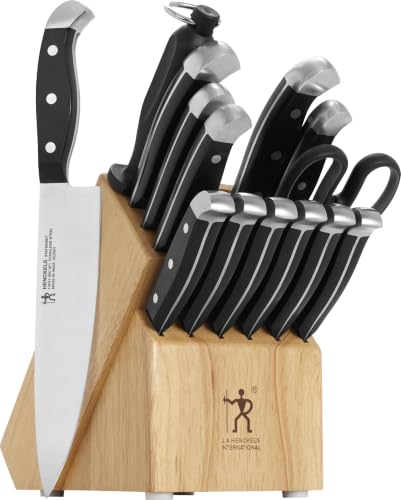
Your first real knife set may be a kitchen purchase you keep for decades. It is also easy to get wrong, because packaging and listings push you toward more pieces, more steel types and more marketing jargon than you need. This guide covers what a beginner should actually look at, then points to the sets in our lineup that fit.
We do not run our own kitchen trials. We compare the specs makers publish on their official pages, and where Bon Appétit ran its own testing we credit it by name.
The Three Knives That Matter
Bon Appétit’s editors follow one rule: three knives, a chef’s, a paring and a bread knife, are all most home cooks need. After years of testing knives, they also note that many of the pieces in an 18-piece block stay factory sharp because nobody ever uses them. Buying knives one at a time can cost more, so a set can still make sense, but judge it on the three essentials.
The chef’s knife does most of the work: chopping onions, slicing vegetables, cutting up meat. Eight inches is the common size, and every set in our lineup includes an 8-inch chef’s knife. The paring knife is for small, in-hand jobs such as hulling strawberries, trimming and peeling. The bread knife has a serrated edge that saws through crusts and soft interiors without crushing them. A set that gets those three right has done the important work. A honing steel and kitchen shears are the useful extras that most blocks include.
Forged vs. Stamped
A forged knife is made from a single piece of heated steel that is hammered into shape, which tends to produce a thicker, heavier blade with a bolster between blade and handle. A stamped knife is cut from a flat sheet and finished. Henckels describes its Statement blades as single-piece and stamped, and says they are lighter than traditionally forged knives. Wüsthof says its Classic blades are forged from a single block of high-carbon stainless steel.
For a beginner the difference is mostly about feel. A heavier forged chef’s knife feels steady and does some of the work for you. A lighter stamped knife is nimble and less tiring in a long prep session. If you can, hold both in a store before you buy.
Western vs. Japanese Edge
German-style knives, such as Wüsthof Classic or Zwilling Four Star, have a thicker blade and a more durable edge. Japanese-style knives, such as Shun and Miyabi, use thinner blades and sharper, more acute edges. Miyabi, for example, lists a hand-honed 9.5 to 12 degree edge for its Kaizen set. Japanese-style knives slice cleanly but need a gentler cutting surface.
For a first set, we lean Western because it is more forgiving of common beginner habits: rocking too hard, scraping the board or not drying the blade right away. Shun is a good middle ground: Bon Appétit describes its blade shape as a Western-leaning hybrid that adds the precision of a Japanese gyuto.
Honing vs. Sharpening
These are not the same job. Honing, with the steel that comes in most blocks, is a quick pass that keeps the edge straight between uses. Sharpening removes a little steel to rebuild the edge, and you need to do it far less often. Wüsthof says its knives can be honed and sharpened with a hand-held sharpener, an electric sharpener, a steel or a whetstone, and gives its standard sharpening angle as 14 degrees per side, or 10 degrees per side for Asian-style blades such as santokus. It recommends a sharpener from the same brand so the material matches the steel. If you do not want to learn to use a whetstone, a mail-in service is an option.
Care: Hand Wash, Dry, Store
Several makers list their knives as dishwasher safe and still recommend hand washing, and Wüsthof says to wash by hand and towel-dry immediately. Messermeister says never to put its set in a dishwasher. Victorinox lists the Fibrox set as dishwasher safe. The careful habit is the same for every set: wash, dry and put away. Do not leave knives soaking in the sink, where you cannot see the blade.
Cutting boards matter too. Wood or plastic boards are kinder to an edge than glass or stone, and a hard surface will dull any knife quickly. Keep the board stable on the counter, for example on a damp towel, and curl your fingertips away from the blade.
For storage, a block keeps knives within reach and the edges away from other tools. If counter space is tight, a drawer tray such as the one in the Zwilling Pro set is the alternative. Loose knives in a drawer chip and dull each other and are easy to grab by the blade, so use a tray or sleeves.
Five Starter Sets From Our Lineup
These are the sets from our full ranking of the best knife sets that make sense for a first purchase.
Wüsthof Classic 7-Piece
An 8-inch chef's knife, a bread knife and a paring knife in forged German steel, plus a honing steel, shears and a roomy 15-slot block.
This is the set to beat for a beginner. Wüsthof lists a 3.5-inch paring knife, a 6-inch utility knife, an 8-inch chef’s knife, an 8-inch bread knife, a 9-inch honing steel and shears. The blades are forged at 58 HRC with full tang, triple-riveted handles. Bon Appétit calls the Wüsthof Classic line a Western-style favorite and its 8-inch chef’s knife a standout. The 15-slot block leaves room to add steak or boning knives once you know what you cook. It needs hand washing and immediate drying. See the Wüsthof Classic 7-Piece profile.
Victorinox Fibrox 8-Piece
An easy-care working set with nonslip handles, a boning knife, a 10-inch slicer and a lifetime warranty on the knives.
If you want a set that needs little fuss, this is the practical choice. Victorinox says all knives are NSF approved and dishwasher safe, with nonslip Fibrox handles, and that they are made in Switzerland. It pairs a 6-inch boning knife and a 10-inch slicing knife with an 8-inch chef’s knife, an 8-inch bread knife and a 4-inch paring knife. The lifetime warranty covers the knives; the block has a 2-year warranty. Read the Victorinox Fibrox 8-Piece profile.
Zwilling Four Star 8-Piece
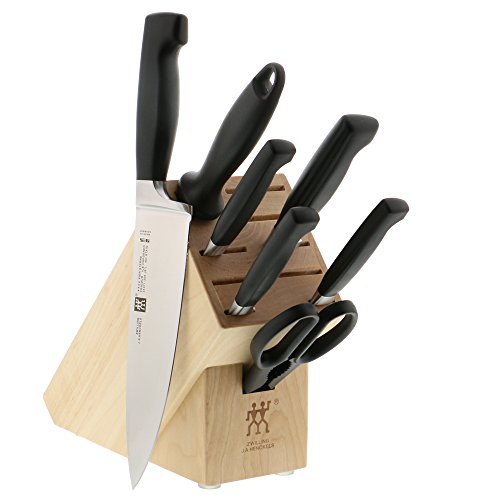
A classic forged German set with a pronounced bolster, a 5.5-inch prep knife and a serrated utility knife.
The Four Star is a familiar forged German set made in Solingen, with precision-forged, ice-hardened blades listed at 57 Rockwell and a lifetime warranty. It includes the three essentials plus a prep knife and a serrated utility knife. Zwilling lists it as dishwasher safe but recommends washing by hand. See the Zwilling Four Star 8-Piece profile.
Shun Classic 7-Piece Essential
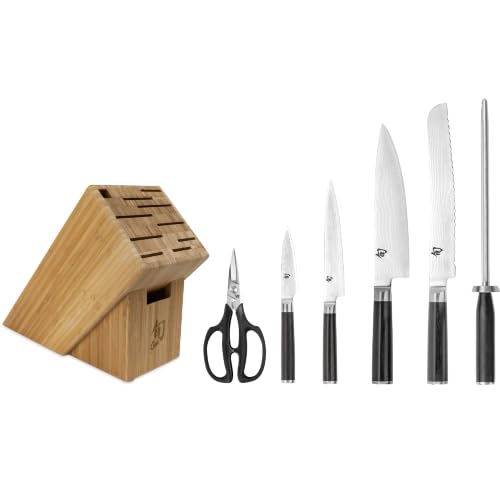
A Japanese-made set with a Western-leaning chef's knife shape and a block with extra open slots.
Choose this if you want a sharper, more refined edge from day one. Bon Appétit named it its best expanded set and says Shun knives are routinely some of the sharpest in its testing. The 9-inch bread knife is a little short for wide loaves, and the herb shears should be hand-washed and dried right away. Shun’s lifetime warranty applies to purchases from authorized dealers. See the Shun Classic 7-Piece Essential profile.
Henckels Statement 15-Piece
The most pieces in our lineup, including two santoku knives and six steak knives, in a lighter stamped design.
For a first apartment where you want everything at once, this set includes a 3-inch paring knife, an 8-inch chef’s knife, an 8-inch bread knife, two santoku knives, a serrated utility knife, six 4.5-inch steak knives, a sharpening steel and shears. Henckels says the blades are stamped and lighter than forged ones. It is the entry-level pick in our ranking, so expect lighter steel in exchange for coverage. See the Henckels Statement 15-Piece profile.
How to Choose
For the sturdiest all-round start, pick the Wüsthof. For easy care, pick the Victorinox. For a sharper Japanese-made edge, pick the Shun. For the most pieces in a first kitchen, pick the Henckels. Whichever you buy, hone regularly, hand-wash, dry the blades and give the knives a proper board and a safe place to live. If counter space is tight, see our guide to the best knife set for a drawer.
Sources
- WÜSTHOF Classic 7-Piece Knife Block Set official product page
- Victorinox Fibrox 8-piece block set official product page
- Victorinox lifetime warranty
- Zwilling Four Star 8-pc knife block set official product page
- Shun Classic 7-Piece Essential Block Set official product page
- Shun warranty and service page
- Henckels Statement 15-pc knife block set official product page
- Miyabi Kaizen 7-pc Knife Block Set official product page (Zwilling US)
- Messermeister Avanta Pakkawood 10-piece knife block set official product page
- Bon Appétit: best knife sets
Frequently asked questions
What knives does a beginner actually need?
Bon Appétit's rule is that a chef's knife, a paring knife and a bread knife are all most home cooks need. Everything else, such as steak knives, a boning knife or a santoku, is a convenience you can add later.
Should a beginner buy a big 15-piece set?
Only if you will use the extra pieces. Bon Appétit warns that many knives in a large block often stay factory sharp because they never get used. A smaller set with a good chef's knife usually serves a beginner better, though a big set like the Henckels Statement 15-Piece is a fair choice if you want steak knives and two santoku knives included.
Is a forged or a stamped knife better for a beginner?
Neither is wrong. Forged knives, such as the Wüsthof Classic, are heavier and have a bolster. Henckels says its Statement blades are stamped and lighter than traditionally forged knives. Hold a heavy chef's knife and a light one if you can, and choose the weight that feels controlled in your hand.
What is the difference between honing and sharpening?
Honing with a steel is routine upkeep that keeps the edge aligned between uses. Sharpening removes metal to create a new edge, using a whetstone, a hand-held sharpener or a mail-in service. Wüsthof says its knives can be honed and sharpened with a hand-held sharpener, an electric sharpener, a steel or a whetstone.
Can I put my knives in the dishwasher?
Check the maker. Victorinox lists its Fibrox set as dishwasher safe, while Wüsthof says to wash by hand and towel-dry immediately and Messermeister says never to use a dishwasher. Even where a dishwasher is allowed, hand washing is the more careful habit.
Are Japanese knives too delicate for beginners?
They are not delicate, but they use thinner, more acute edges, such as Miyabi's 9.5 to 12 degree edge, and reward a gentle cutting surface. A Western-style set like the Wüsthof Classic is more forgiving of rough habits, while Shun's blades are a Western-leaning hybrid.